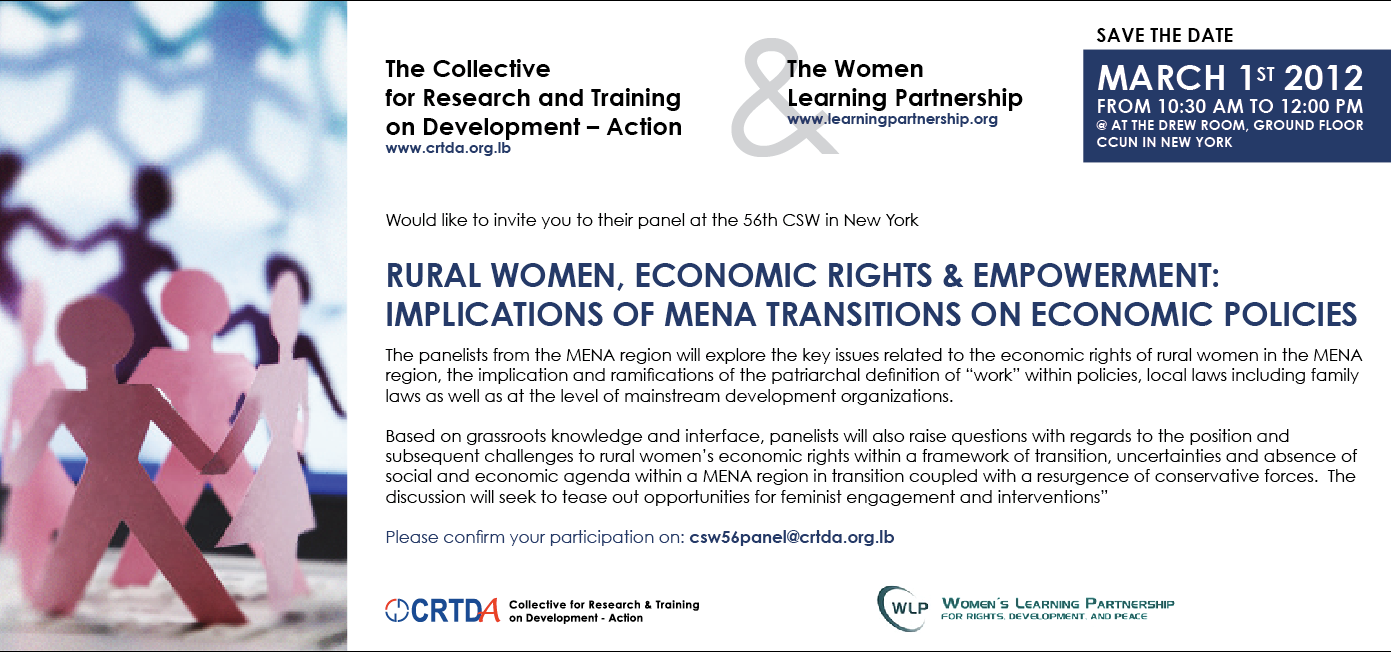
Event Details
-
Time
10:30am
-
Date
01 Mar, 2012
-
Location
- CCUN Building
- New York, NY
-
Contact
WLP
This panel discussion is presented by Collective for Research and Training on Development-Action (CRTD-A) and WLP as a parallel event at the 56th Session of the UN Commission on the Status of Women (CSW). Panelists from the MENA region will explore key issues related to economic rights of rural women in the MENA region.
CRTD-A, in collaboration with WLP, has been involved in working on leadership and women's rights for more than a decade. Much of this work has focused on rural women's economic rights, political participation, and empowerment, based on an understanding of empowerment in which women have a voice, opportunities, and full participation in civic life.
Women in the MENA region face myriad challenges, among the most critical of which is the invisibility of and poor value attributed to rural women's work. The importance of rural women's care work in securing the lives and livelihoods of those in rural communities cannot be overemphasized. Challenges faced by rural women are compounded by restricted access to property and assets, lack of effective judicial institutions, poverty, the absence of care infrastructure and services including protection from violence, and discriminatory practices against rural women and girls.
In the wake of the events of the Arab Spring, we note with concern that promoting the interests of and opportunities for rural women have not been high on the agenda of the emerging social change movement. Building on critical analysis and our own experience, this panel will share case studies from the MENA region and beyond, and will explore key aspects of rural women's economic rights, participation, and empowerment, including rural women and the informal economy, unpaid care work, leadership and political participation, and access to financial resources.
Case studies will be shared by women's rights advocates with a wealth of experience working with women in rural areas, and who are currently involved in the processes of change in the MENA region. Panelists will share information, analysis, and their own experience, and will engage in dialogue with participants from other regions.