
Equality is often debated in parliaments, negotiated in international forums, and measured through policy frameworks. But its most consequential battleground is far closer to home. Within the structures of family life—where decisions about resources, autonomy, and dignity are made daily—law quietly defines who holds power and who does not.
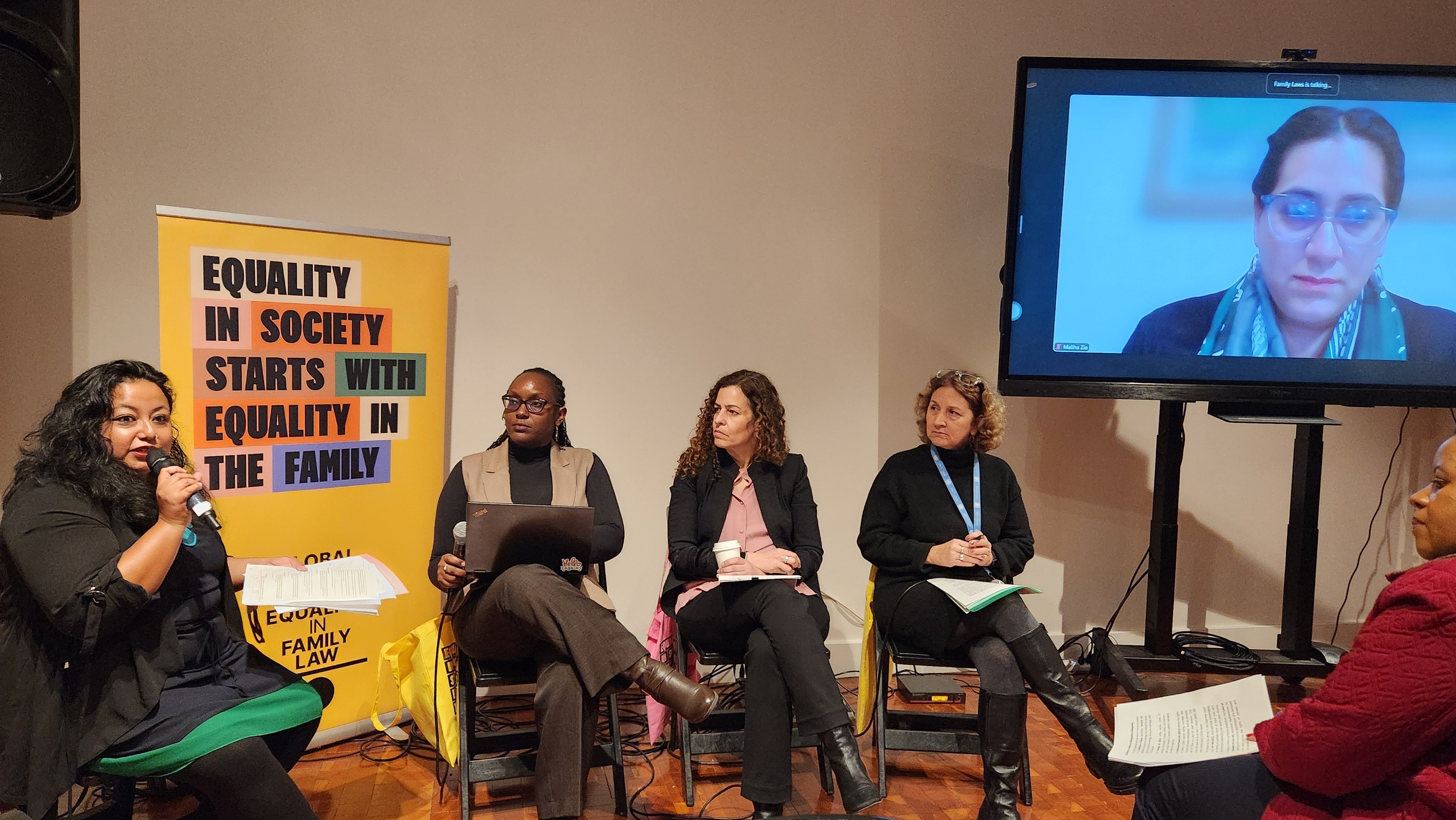
At the 70th session of the Commission on the Status of Women (CSW70), Women’s Learning Partnership (WLP), as part of the Global Campaign for Equality in Family Law (GCEFL), convened a powerful side event to address one of the most persistent, and often overlooked, barriers to gender justice — inequality within the family. The event, titled “Envisioning Equality: The Case for Egalitarian Family Law Reform,” featured government representatives, UN experts, and civil society leaders who shared global, regional, and national perspectives on family law.
Why Family Law Matters
Across contexts, family laws shape the most intimate and foundational aspects of people’s lives — marriage, divorce, custody, inheritance, and economic rights. Yet, in many parts of the world, these laws continue to institutionalize inequality.
While the Universal Declaration of Human Rights (UDHR) points to the family as the foundational unit of society, what is meant by ‘family’ is left up to interpretation.
“That has given a lot of space for conservative forces to try to argue that there's one version of the family, and that version of the family comes along with some pretty serious assumptions about women's roles and men's roles and what the family should look like,” explained Claudia Flores, Chair of the UN Working Group on Discrimination Against Women and Girls.
When family laws are defined without equality in mind, it is predominantly women who suffer the consequences. Family law determines who controls property and financial resources, who has decision-making power within households, and who is able to exit harmful relationships or obtain access to justice. Evidence has shown that discriminatory family laws impact women's economic, social, and political participation across multiple contexts. Without equality in family law, broader gender equality remains structurally incomplete.
From Global Norms to Lived Realities
Discriminatory family laws are not unique to a singular country or region. Across the globe, we are seeing that justice does not begin in the courts – it begins in the family. During the event, speakers highlighted both the universality of the challenge and the diversity of pathways to reform.
At the Global Level:
When looking at family law from the global perspective, Yamila González Ferrer, CEDAW Committee Expert, underscored that discriminatory laws operate across multiple layers:
- Explicit discrimination (e.g., unequal divorce or inheritance rights)
- Hidden inequalities (e.g., lack of recognition of unpaid care work or economically unprotected in divorce proceedings)
- Plural legal systems where religious or customary laws override equality
- Gender-based violence embedded within family structures
It is not enough for a country to have laws that appear gender neutral; states must pursue substantive equality, addressing how laws function in practice.
At the Regional Level:
Using the recent report from the Africa Family Law Network (AFLN), Esther Waweru, Associate Director of Legal Equality at Equality Now, revealed that inequality is not isolated but systemic.
Many countries operate under plural legal systems in which civil, customary, or religious doctrines play a powerful role in how laws are interpreted, worded, or enacted. Across the African continent, practices such as polygamy, unequal divorce rights, discriminatory inheritance and custody practices, and domestic violence – including marital rape and femicide – continue to persist.
Yet, there are also powerful tools for change. “I think it's important to recognize that governments have ratified regional, international instruments,” Waweru said. “And it's therefore important and absolutely critical, for us to prioritize harmonization of civil, religious, and customary family laws to ensure equality and non-discrimination.”
The ratification of the Maputo Protocol, for example, set a powerful foundation for the rights of women and girls across Africa, and it has become a blueprint to advocate for reform of discriminatory family laws. In her remarks, Aurelia Chepkirui Rono, the Principal Secretary for the State Department for Parliamentary Affairs within the Office of the Prime Minister's Secretary of Kenya, explained that it played a pivotal role in shaping the progressive gender equality provisions in Kenya’s 2010 Constitution.
At the National Level:
Maliha Zia, Director of Gender, Inclusion, & Development at Legal Aid Society, discussed the context of family law in Pakistan, highlighting among other issues, the importance of implementation of family law reform.
Over the past few decades, Pakistan has achieved significant legal progress in the context of women’s rights. Women’s movements have been central drivers of change, passing concrete laws that cover topics such as women’s unilateral right to divorce, more progressive marriage contracts, and raising the legal age of marriage to 18. However, implementation gaps and judicial interpretation remain substantial barriers.
A major driver of inequality in Pakistan is women’s economic rights within marriage, particularly the distribution of matrimonial property. If women have access to a share of the property accumulated during the course of marriage, they will have more economic independence and personal agency, and it may also help reshape the way men view their wives – as equals rather than dependents.
From Movement Knowledge to Global Policy
The importance of family law reform is increasingly reflected in global policy frameworks. In his 2026 report to CSW70, the UN Secretary-General directly references analysis from the GCEFL, citing an expert paper by Hyshyama Hamin highlighting the impact of discriminatory family laws. The Agreed Conclusions reached during this year’s CSW also mention the importance of amending discriminatory family laws. This recognition underscores a critical shift. Feminist legal advocacy and movement knowledge are not only informing dialogue, but shaping global policy agendas on access to justice and gender equality.
What Does Egalitarian Family Law Look Like?
The current moment is marked by both progress and pushback. Across regions, there is a resurgence of “traditional family values” used to justify inequality, increasing efforts to redefine the “family” in exclusionary ways, and organized resistance to gender equality frameworks.
At the same time, there is also a growing recognition that families are diverse and evolving, and that equality within families strengthens democracy, economic development, and social cohesion. Reform is not only possible, but already underway in many contexts.
When envisioning an egalitarian future, several shared principles emerged:
1.Equality as a legal and lived reality
Laws must ensure equal rights:
- before and during marriage and unions
- at its dissolution
- in access to property, inheritance, and resources
2. Recognition of women as full rights-holders
Every individual within the family, not the family unit alone, must be recognized as a rights-bearing person.
3. Economic justice at the core
Valuing unpaid care work and ensuring equitable distribution of assets is essential to shifting power dynamics.
4. Inclusion of diverse family forms
Legal systems must reflect the reality of families as they exist — not as narrowly defined ideals.
5. Accountability and implementation
Reform requires:
- political will
- budgets
- judicial training
- access to justice
- monitoring mechanisms
As one speaker noted, laws alone do not transform societies — implementation and culture must follow.
6. The Role of Movements and Partnerships
A consistent thread throughout the discussion was the indispensable role of women’s rights movements. Legal reform does not happen in isolation, it is built over generations of organizing, sustained through coalitions, and strengthened through cross-regional learning.
“The rights of women and girls are not up for negotiation. Only through determined, coordinated, and cross-sectoral action can we secure full equality, dignity, and access to justice for all. And justice starts in the family.”
– Ms. Elisabeth White, Deputy Director within the Division for Gender Equality at the Swedish Ministry of Employment
WLP’s Role: From Legal Reform to Democratic Practice
For WLP, this conversation sits at the heart of our work.
Family law reform is not only a legal issue, it is a democratic practice issue. It shapes women’s agency and voice, economic participation, leadership pathways, and the ability to participate fully in public life.
Through our partnerships across the Global South, WLP supports:
- movement-based advocacy for legal reform
- leadership development for women changemakers
- cross-cultural dialogue on rights and justice
- strategies that bridge law, culture, and community
As this event affirmed, transforming family law is foundational to transforming societies.
Looking Ahead: From Vision to Action
The session closed with a clear call:
- We cannot afford to treat inequality in the family as a private issue.
- It is a public, political, and structural challenge.
Moving forward, accelerating progress will require:
- stronger alignment between global frameworks (CEDAW, UN mechanisms) and national reforms
- deeper investment in grassroots movements strategic engagement with cultural and religious actors
- sustained cross-regional collaboration
Above all, it requires holding onto a bold but necessary vision: A world where equality begins at home and extends into every sphere of life.