
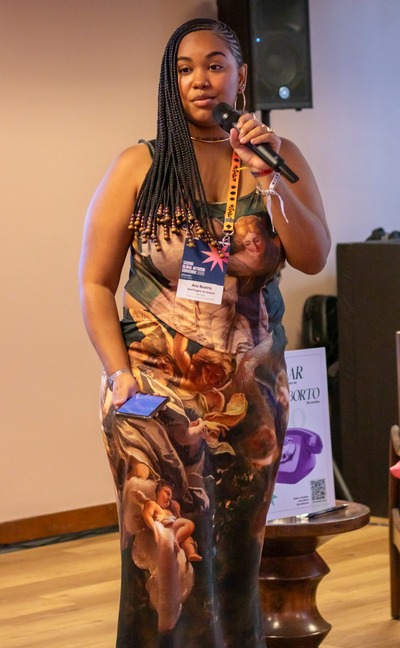
At the Second Global Artivism Conference in Salvador, Bahia, one of the most resonant voices in WLP’s session “From Protest to Performance: Artivism for Gender Justice” was that of Brazilian artivist Lady B, a young Black singer, poet, and long-time collaborator of WLP partner CEPIA.
Lady B’s work embodies one of WLP’s core pillars: narrative power and artivism as tools to shift culture. Through music, poetry, and performance, she transforms lived experience into collective reflection, and personal testimony into political imagination.
In this interview, Lady B reflects on how art became her language of resistance, what artivism means in practice, and how creativity can reshape the stories that govern whose lives, bodies, and futures matter.
***
What inspired you to transform your music, poetry, and performance into tools for activism?
The reality around me was and continues to be the biggest driving force behind incorporating my voice, my ideas, and what I believe in through my art.
For Lady B, artivism does not begin in theory, it begins in lived experience. Her work grows directly out of the social and political conditions that surround her, and from a conviction that voice itself is a form of agency.
How did your upbringing in Morro da Coroa shape your vision of justice, community, and creativity?
Experiencing the various realities and nuances of being born, raised, and growing up in the favela allowed me to closely observe the diverse inequities related to access to basic services, such as the right to life; thus, throughout my growth and maturation as a Black woman from the periphery, I have built (and continue to build) a perspective that goes beyond my own reality, encompassing the experiences of my peers.
Her perspective reflects a core insight of feminist narrative work: that culture shifts when marginalized communities tell their own stories, in their own language, grounded in collective experience.
What does the word “artivism” mean to you, personally and politically?
Artivism for me is a movement that touches others, it's collective work even within an individual body, it's attitude, it's the will to be and to change realities.
In Lady B’s definition, artivism is not performance alone. It is collective action, embodied resistance, and political will. Even a single voice, she suggests, carries the weight of many.
Your collaboration with CEPIA has lasted for many years. What has this collaboration given you as an artist and feminist?
My connection with CEPIA spans not only years, but also important phases of my trajectory and growth as an artist and activist. It was at CEPIA that I discovered feminism in an active way and at CEPIA I found space for struggle for me and for what I believe in; furthermore, it was also there that I found a place where I feel welcomed, safe, and extremely inspired, both by its feminist and justice-seeking perspective represented through its female leadership and by its impactful actions; therefore, I see this partnership as an important and necessary link within my work in the field of art and activist struggle.
This partnership illustrates how movement infrastructure and creative practice reinforce each other. Artivism thrives where there is feminist leadership, political clarity, and institutional space for experimentation and courage.
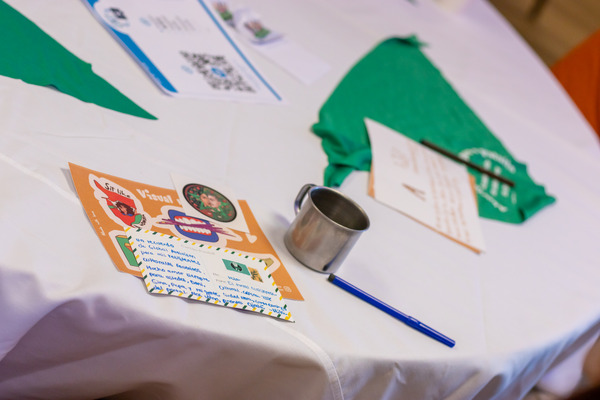
What did it mean for you to participate in the Global Artivism Conference in Salvador, and what moments or conversations stood out in your memory?
Being at the Global Artivism Conference in Salvador was an unforgettable and extremely powerful experience in the sense of getting to know so many cultures, struggles, and agendas vibrating in one direction: artivism as a strategy for social change and reflection. For me, two moments stand out: the first was participating in a session that used the power of music to talk about the past, present, and future through Afrofuturism as an ancestral technology; and the other moment was the presentation of our own session "From Protest to Performance: Artivism for Gender Justice," seeing it concrete and happening filled my heart with pride in the face of such an important agenda and a work done by many hands with so much dedication and drive.
Her reflection captures what WLP understands as the transnational power of narrative: when stories, struggles, and creative traditions travel across borders, they generate shared political imagination.
When presenting “My Womb, My Decision,” what message did you hope to convey, especially to women and young girls?
The message I wish to convey with “My Womb, My Decision” is that for many people, a woman's body is seen as a space of dispute and control; but the reality is that women themselves hold the right to that body and its decisions; and that through our activism in the present, we can change our future.
Here, art becomes a direct intervention in one of the most contested cultural terrains: who controls women’s bodies, narratives, and futures.
How do you transform your life experience into art that resonates with different audiences and social realities?
I try to provoke, through my perspective, discomfort in the face of diverse situations and realities from different spheres of society; and through this provocation, I use self-reflection as a strategy to reach those who listen to my art.
Provocation, reflection, and resonance; these are the mechanisms through which narrative power reshapes culture.
What injustices or silences do you feel most motivated to challenge through your art right now?
The main themes that affect me are racism, gender violence, police violence, and social inequality.
These are not abstract themes. They are the fault lines along which cultural narratives, and material lives, are organized.
If you could speak directly to the next generation of young activist artists, what would you want them to carry forward?
Don't let your present moment define your future. Art transforms lives, changes trajectories, and uses the uniqueness of each person's essence as a tool for change in the world. You too can transform your reality.
***
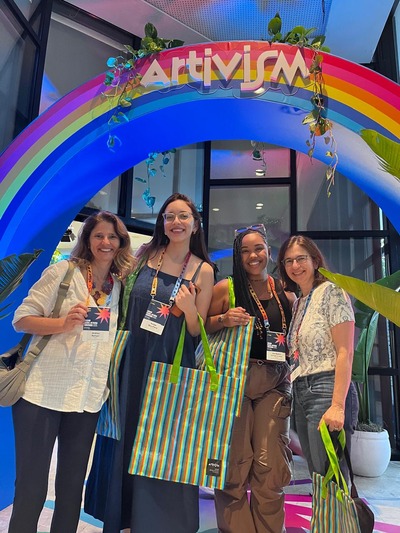
Artivism as Narrative Power
Lady B’s work exemplifies what WLP means by narrative power: the capacity of creative expression to reshape norms, humanize policy debates, and expand the boundaries of political possibility.
In a moment of global backlash against feminist movements, shrinking civic space, and rising authoritarianism, her voice reminds us that:
- Culture shifts before laws change.
- Stories open doors where arguments fail.
- Imagination is a form of political infrastructure.
Through artivists like Lady B, and through partnerships like WLP and CEPIA, narrative power becomes not only a method of expression, but a strategy for justice.