
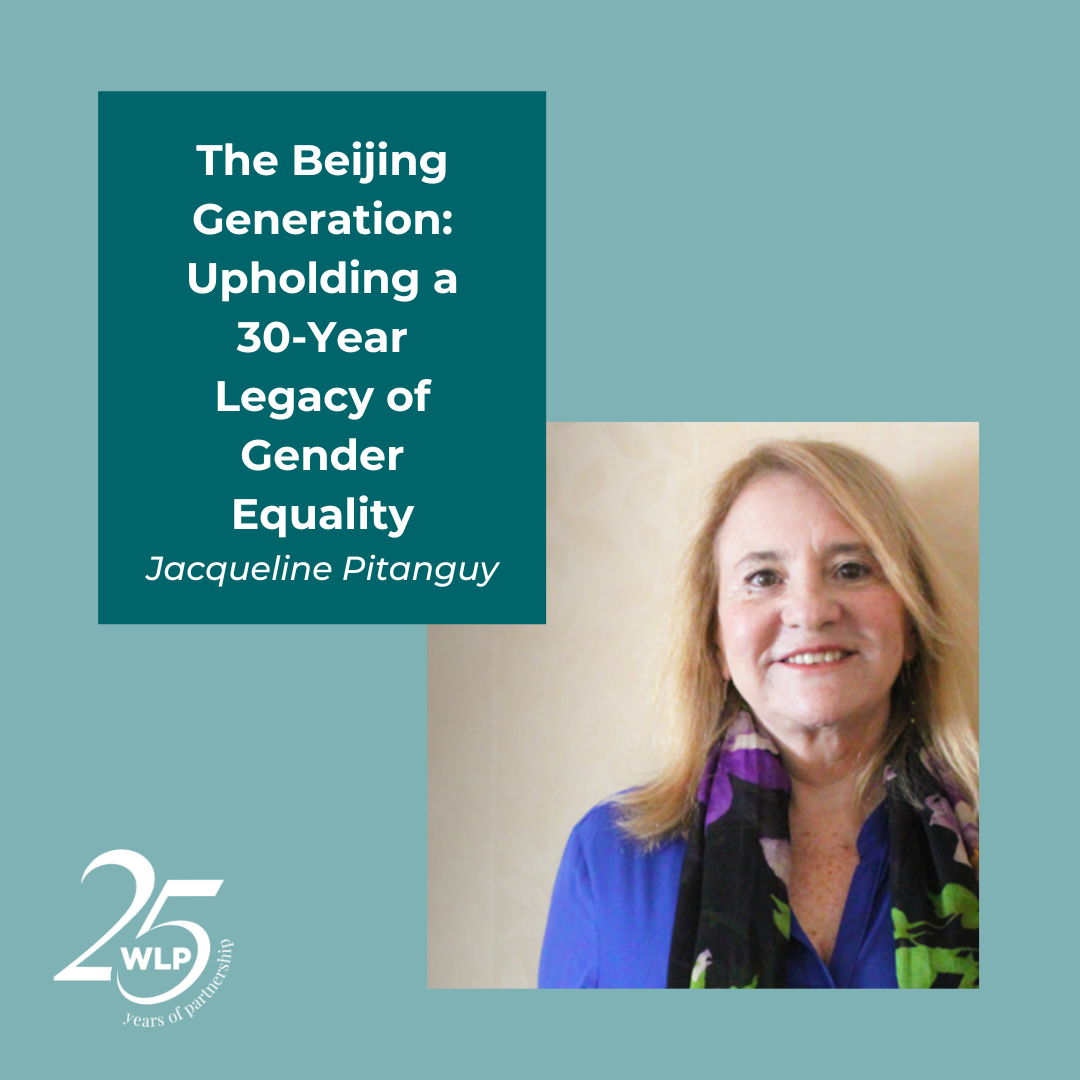
I arrived in Beijing in 1995 as part of a small international group of women called HERA, organized by the International Women’s Health Coalition, IWHC. We were all quite experienced in doing advocacy in the UN arena, from Prep Coms to Conferences themselves. We were particularly influenced by the 1994 Cairo Population and Development Conference where women’s organizations were the main protagonists and where, against strong opposition from conservative and religious groups, we succeeded in introducing the concepts of reproductive rights, reproductive and sexual health, and gender in a UN document for the first time.
I was part of the Brazilian Delegation and together with other member delegations of HERA, including the one from the United States, we collectively strategized to influence our governments.
It is important to look at the Beijing Conference as one step in a long pilgrimage of women from different parts of the world, from a variety of cultures and political systems, that have been marching together to fully realize women’s rights. This pilgrimage started in Rio at the 1992 Conference on the Environment, continued to Vienna’s Human Rights Conference in 1993 which proclaimed that violence against women was a human rights violation, and that human rights are integral, indivisible, and inalienable. The next stop was Cairo in 1994 before the pilgrimage arrived in Beijing in 1995, where the political agreements that had been reached at the three previous conferences were consolidated to close any remaining gaps to secure the equality of women with men in the law and in practice.
The Beijing Declaration and Platform for Action, a global agenda for women’s empowerment that addresses a wide range of issues affecting women, including poverty, education, health, gender-based violence, participation in decision-making, and the effects of environmental impact on women.
The Declaration affirms that the human rights of women and girls are an inalienable, integral and indivisible part of all human rights and fundamental freedoms. It emphasizes the right to freedom of thought, the right to equality in the family, the right of women to control their fertility, and highlights the need to implement gender sensitive policies and eliminate all forms of discrimination. If truly implemented by the 189 governments who endorsed and signed this document, the world would be in a different stage of achieving gender equality and human dignity for all. But this is not so.
When we think of challenges and barriers to implementing Beijing’s Platform for Action, we must understand the context in which the Conference took place and the world as it is today. In 1995, multilateralism was a strong value among nations and women’s rights and the idea of gender equality were part of the political agenda of many countries, NGOs were important political actors and women’s movements, working nationally and in regional and international coalitions, had influence in political parties, local governments and in the UN arena. Gender equality was recognized by many countries as a key component of democracy and was supported by new legislation and the reform of discriminatory legal codes. Moreover, this agenda was backed by major funders from both the private and public sectors.
However, women are not a homogenous group. Race, ethnicity, socioeconomic status, sexual orientation, among other identities, create further barriers to the achievement of rights that are theoretically guaranteed for all. The feminist movement has been expanded and enriched with black and indigenous women’s organizations, and the concept of democracy and pluralism expanded with the inclusion of the LGBTQ+ agenda and climate change brought the environment to the center of the multilateral discussions.
Today the scenario is more complex in terms of the civil society agenda, which is positive. However, global neoliberal economic trends have increased inequality and the concentration of wealth, multilateral institutions are losing ground to populist ideas of national sovereignty, and the extreme right, based on conservative patriarchal values, religious and secular, constitute a major force affecting gender equality and women’s rights.
I believe that resistance is key to preserving what we have achieved in Beijing, which is being constantly threatened. To do so, it is necessary to rebuild, maintain, and expand women’s rights coalitions, to build alliances with other civil society organizations that have race, ethnicity, gender identity, and the environment at the center of their agenda, and build joint strategies to disseminate to the youth and society at large - knowledge about past achievements and how to defend and advance the agenda.
The speed and reach in which we operate today due to the IT revolution is very different from that of the nineties, and today we must use social media with the same expertise as our adversaries do.
And most importantly, we must keep our hope and energy to keep walking in this never ending pilgrimage.
As the poet Machado said:
Caminante no hay camino se hace camino al andar
(Traveler, there is no path. You make your own path as you walk.)