
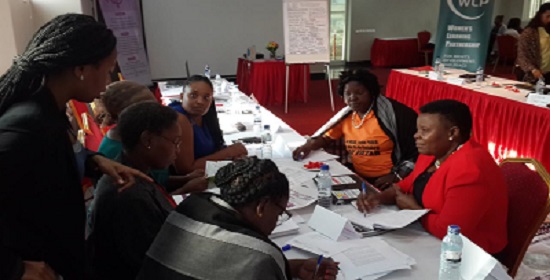
Trainers and facilitators at the TOT discuss eliminating gender-based violence.
WLP’s partner in Mozambique, Forum Mulher, hosted the “Lusophone Africa Regional Training of Trainers (TOT) for Women’s Leadership and Political Participation” from May 25 to 30, 2015 in Mozambique’s capital city, Maputo. Activists, parliamentarians, trade unionists, and lawyers from three Portuguese-speaking African countries—Mozambique, Angola, and Cape Verde—participated in sessions on eliminating gender-based violence (GBV) and increasing women’s access to decision-making positions. Andrea Romani of WLP’s partner in Brazil, CEPIA, co-facilitated the TOT with trainers from Forum Mulher.
Facilitators used WLP’s manual on ensuring women and girls’ freedom from violence, Victories over Violence, to address the issue of GBV in their own cultural contexts. Reflections on the manual’s case studies led to discussions on the ways violence against women persists in the participants’ respective communities. For example, ritos de iniciação, or initiation rites, in Mozambique and Angola play a crucial role in passing down gender roles from one generation to the next. Initiation rites usher boys and girls into adulthood through a series of traditional ceremonies that often teach valuable sex education, but also reinforce patriarchal structures that place girls in subservient roles at home, and can subject women and girls to harmful practices such as forced marriage, early marriage, and other forms of violence.
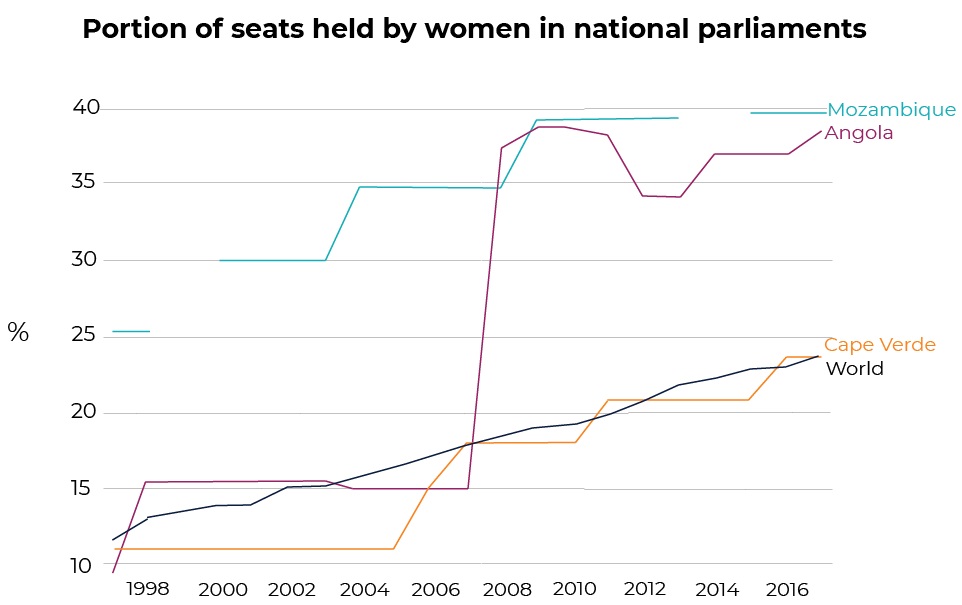
Source: World Bank
Recognizing that women’s involvement in decision-making is crucial to making progress on GBV and other issues, the TOT also focused on strategies for mobilizing women’s political participation. Facilitators guided sessions on engaging in the political process through traditional political parties, as well as independently. Participants learned strategies on how to tackle the issue of women’s low representation in government. Worldwide, women hold an average of just 23.6 percent of seats in national parliaments. Cape Verde’s ratio of women parliamentarians reflects that average, while in Mozambique and Angola women hold 39.6 and 38.2 percent of seats, respectively.
Representation of women in government does not automatically lead to equal rights for women in society, however. Participants at the TOT discussed the barriers to women’s involvement in politics, such as negative stereotypes and a lack of funding sources, as well as ways to overcome these barriers. WLP’s political participation training aims both to empower women to reach decision-making positions, and to inspire men and women in those positions to promote women’s advancement and feminist ideals in their policy agendas.
An enduring outcome of the TOT was a sense of solidarity and commitment among participants to continue to work together. By sharing their experiences, participants strengthened their networks and created plans for future collaboration. They committed to organizing step-down workshops by December 2015, which will spread the WLP methodology and knowledge they acquired to their respective communities and organizations. WLP Brazil and WLP Mozambique will continue to work together to mentor and follow up with the participants as they carry out their action plans.