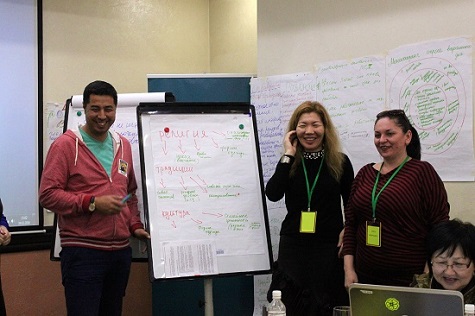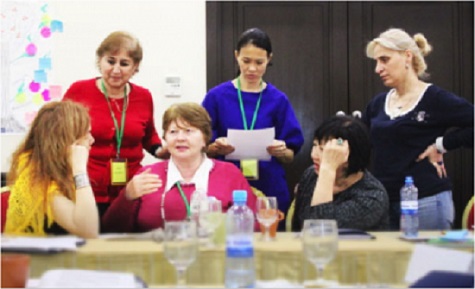
Women’s rights activists from Central Asia gathered in Almaty, Kazakhstan for a four-day Training of Trainers workshop in February 2016. The participants hailed from all corners of the region, including Armenia, Azerbaijan, Belarus, Georgia, Kazakhstan, Kyrgyzstan, Russia, Tajikistan, Turkmenistan, Ukraine, and Uzbekistan.
Training of Trainers (TOT) workshops provide individuals with the knowledge and tools to facilitate future workshops in their own communities. This system of cascading information has a multiplier effect, allowing WLP’s strategies for women’s empowerment to be more widely spread and also adapted to specific cultural contexts.
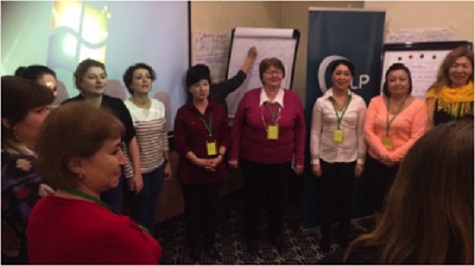
Topics of the TOT included leadership, human rights, strengthening democratic institutions, combatting violence against women, and monitoring and evaluation. Facilitators used WLP’s training manuals Leading to Choices, Leading to a Culture of Democracy, Victories over Violence, and Beyond Equality, as well WLP’s documentary on gender-based violence, From Fear to Freedom.
“The workshop for me personally was the impetus for a new phase in my professional life,” said Uzbekistani journalist Nargis Kosimova. “I realized that I am not alone, but alongside leaders and professionals in their fields who are open to debate and always ready to help."