
CEPIA Advocates for the Future of Gender Equality in Brazil’s Education System
WLP BRAZIL/ Citizen, Study, Research, Information, and Action (CEPIA)
Early in the summer, the Federal Supreme Court of Brazil recognized CEPIA as amicus curiae. With legal standing, CEPIA can provide information and recommendations in a case before the court that will determine federal guidelines for school curriculum. Conservative political and religious groups in Brazil want to prohibit the use of the terms “gender,” “sexuality,” and “gender identities” in public high school curricula. They argue that discussion of these terms threatens traditional family models and promotes sexual immorality. Along with a coalition of other CSOs, CEPIA opposes this prohibition. They argue that the exclusion of these terms from educational curricula reinforces patriarchal and discriminatory gender roles, and allows political and religious forces to interfere with the secular nature of Brazil’s educational system. CEPIA works with teachers in many municipalities, and has trained over 400 students on gender equality, healthy relationships, and leadership. CEPIA has also been working with officials from the Department of Education to encourage the adoption of gender-equal perspectives in their educational programs.
Participants of FWID Training Lead Their Own Workshop on Equality in the Family in Palestine
WLP EGYPT/ Forum for Women in Development (FWID)
Two participants in FWID’s training on gender equality in the family facilitated their own gender equality training with members of the General Union of Palestinian Women. In January 2020, Amal Aga and Sonia Abbas’s workshop explored themes of culture and gender roles in the family. Before beginning a discussion with participants on family law reform and steps for action, they screened WLP’s documentary film, Equality: It’s All in the Family. FWID looks forward to continuing to engage and support its networks, including its Palestinian allies, to advocate for the reform of discriminatory family laws and practices.
SIGI-J Brings Together Media Personalities & Civil Society Leaders for the Arabic Premiere of the New Documentary Film from WLP
WLP JORDAN/Solidarity is Global Institute/Jordan (SIGI-J)
On June 18, SIGI-J brought together three media personalities to serve as panelists for the Arabic premiere of the new documentary film from WLP, It’s Up to Us. The film was screened before a live online audience and was followed by a panel discussion, which included actress Nadera Emran, film critic and the managing editor of the national newspaper Al Rai Hussein Dasah, TV presenter and director Ghada Saba, CEO of SIGI-J Asma Khader, and SIGI-J President Enaam Al Asha. The event has been viewed over 1,000 times on SIGI-J’s Facebook page. The film screening is part of SIGI-J’s “Creativity for Life,” series, which highlights the intersection of art and human rights.
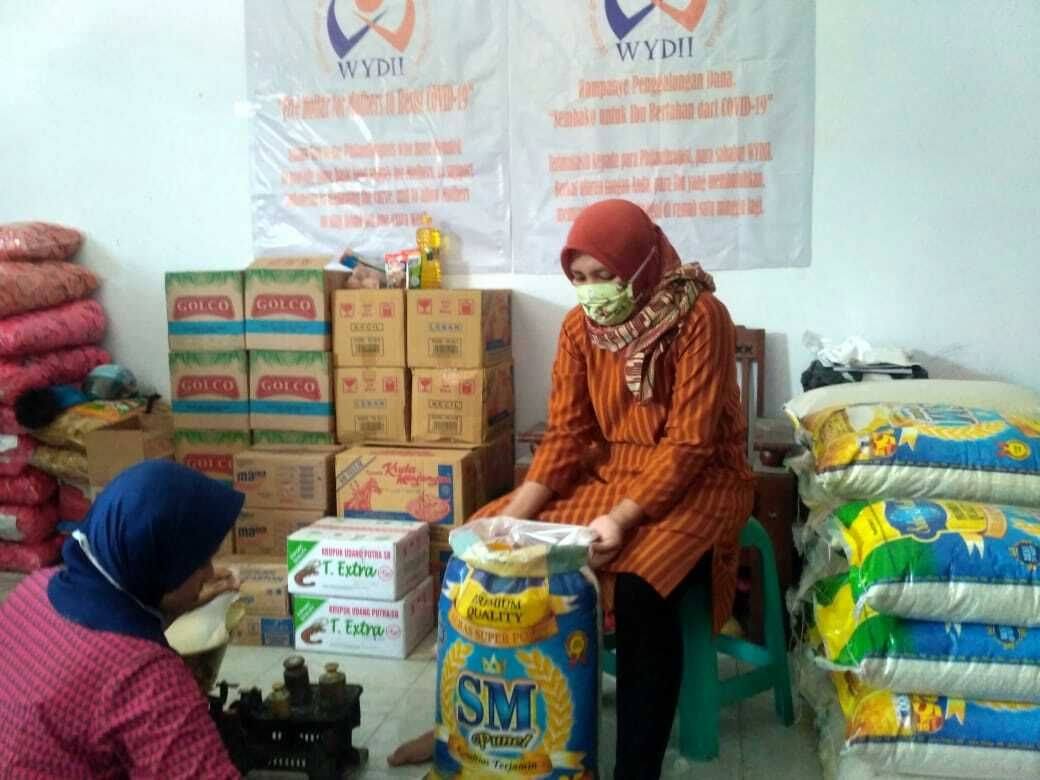
Staff from WLP Indonesia/WYDII package up food to distribute to families in the East Java province as part of their “Dollars for Mothers” COVID-19 response.
WYDII Feeds Over 600 Families in Indonesia
WLP INDONESIA/ Women and Youth Development Institute of Indonesia (WYDII)
WYDII has raised funds to fight hunger, and to-date has fed over 600 families in the East Java province of Indonesia through its online “Dollars for Mothers” campaign. Indonesia has the highest number of reported coronavirus infections in South East Asia, and social distancing guidelines are unevenly adhered to. Those working in the informal sector are reluctant to get tested, afraid of the social stigma if they test positive. Many families with women heads of household, relying on their informal labor for income, are struggling to make ends meet. In the current situation, many mothers are choosing to risk exposure to COVID-19 in order to feed their families. WYDII’s efforts are helping to alleviate some of the financial stress these mothers are facing.
SWRC Trains 100 women in Kazakhstan on the UN Sustainable Development Goals
WLP KAZAKHSTAN/ Shymkent Women's Resource Center (SWRC)
SWRC is facilitating trainings on the United Nations’ 2030 Agenda for Sustainable Development and the sustainable development goals (SDGs). SWRC’s lead trainer, Lyazyat Askarova, held a series of seven online trainings in June for nearly 100 women titled "Involving Women in the implementation of the UN Sustainable Development Goals in Kazakhstan.” The participants learned about the seventeen SDGs and how to incorporate the goals into their lives. To ensure that the digital divide did not exclude those with limited internet access, SWRC held an additional, two-day in-person training for another 24 participants in Taraz, Kazakhstan.
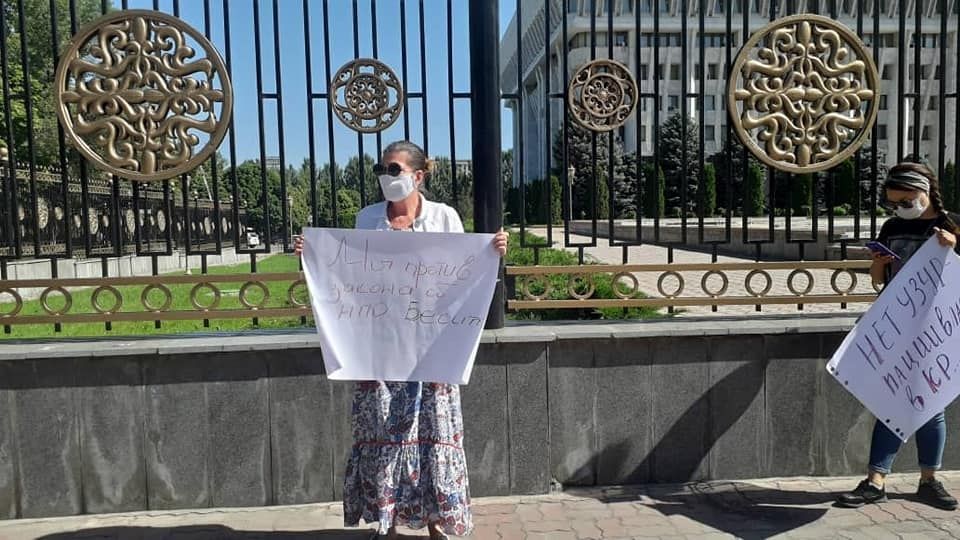
Members of WLP Kyrgyzstan/Bir Duino rally outside of parliament to protest a new bill that would further restrict CSOs in the country.
Bir Duino Protests Bill that Restricts Civil Society Action in Kyrgyzstan
WLP KYRGYZSTAN/Bir-Duino
Members of Bir Duino rallied outside of Parliament in May, demanding the recall of a bill that constrains the activities of civil society. The bill requires NGOs to conduct additional, onerous, reporting on their grants and finances. The government, political parties, and religious organizations that receive funding are not subject to the new requirements, which activists say are intended to harass organizations and restrict their ability to raise funds. Parliament is taking this action at a time when Kyrgyz civil society is consumed with responding to the pandemic, and has little capacity to draw international attention to the government’s repressive action. In a press release, Bir Duino condemned the law, saying that it “is aimed against the freedom of association in the Kyrgyz Republic, contradicts international standards and the Constitution of the Kyrgyz Republic, and aims to create artificial barriers, corruption control mechanisms, and bureaucracy.”
http://birduino.kg/en/press/stop-discrimination-and-narrowing-the-space-for-ngos-in-kyrgyzstan!
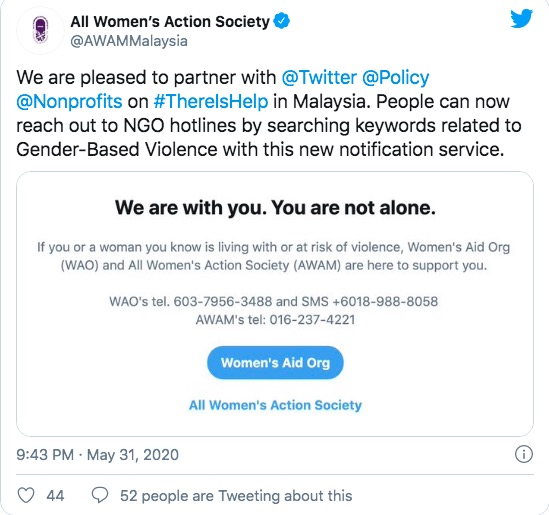
A tweet from WLP Malaysia/AWAM shows the notification Twitter users will receive to direct them to services that address violence against women.
AWAM Partners with Twitter to End Gender-Based Violence
WLP MALAYSIA/ All Women's Action Society (AWAM)
AWAM has partnered with Twitter under its #ThereIsHelp tool to connect those in abusive situations with help and services. When Twitter users in Malaysia type key words associated with gender-based violence into the search bar, Twitter will send them a notification and direct them to AWAM’s hotline and other local services for victims of violence. The partnership between Twitter and Malaysian NGOs is helping to address a recent 57 percent increase in hotline cases reported by Malaysia’s Ministry of Women, Family, and Community Development (KPWK). The initiative is part of AWAM’s robust digital response to the COVID-19 pandemic in Malaysia, which has included educational graphics, distributing domestic violence hotline information, and more.
“While the pandemic affects everyone, women and girls are more vulnerable to violence and abuse, including economic factors that disproportionately affect women such as period poverty and wage inequality. Together with Twitter, we are addressing this suffering.”- AWAM’s Programs and Operations Manager, Nisha Sabanayagam
ADFM Demands that Soulaliyate Women’s Rights to Communal Land Not Be Based on Discriminatory Criteria Established Decades Ago
WLP MOROCCO/Democratic Association of Moroccan Women (ADFM)
ADFM issued a press release in response to a circular published by Morocco’s Minster of the Interior. For decades, ADFM has collaborated with women leaders among the Soulaliyate who have been fighting for equal rights to their communal land and for an equal share in the profits from the sale of that land. Despite the recent passage of legislation protecting women’s rights to communal lands, in May the Interior Minister issued a circular that jeopardizes the progress made by women. The circular’s provisions allow land to be returned to those who blocked Soulaliyate women‘s access for so many years. The circular spells out new criteria for land to be reclaimed by the Soulaliyate—criteria that very few women can meet based on historical and cultural practices that have discriminated against their owning or profiting from the sale of land for hundreds of years.
ADFM and the Soulaliyate leaders are putting the government on notice that they are monitoring the land distribution for its compliance with the Moroccan Constitution’s guarantees of equality
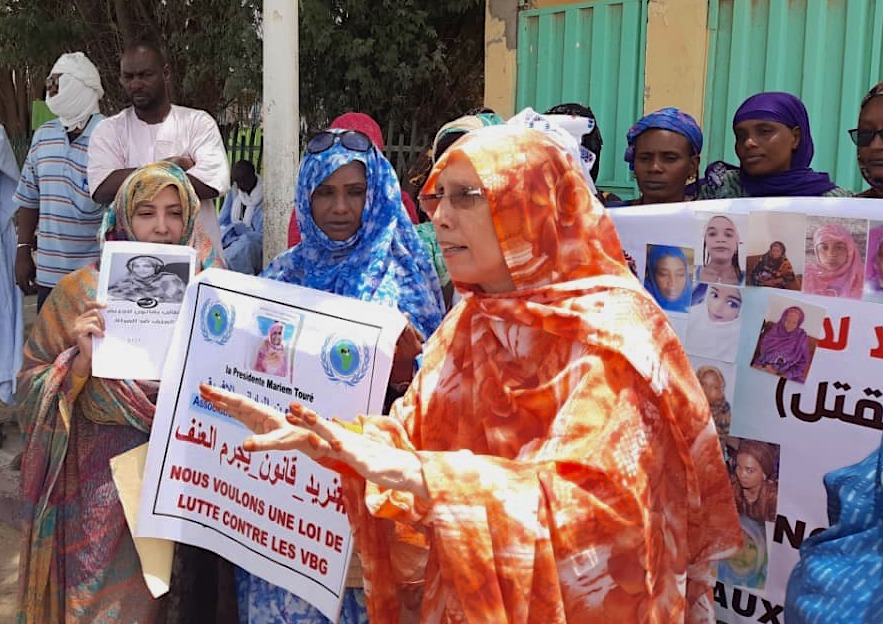
Aminetou Mint El Moctar, President of WLP Mauritania/AFCF leads a demonstration to raise awareness about new legislation to end violence against women.
AFCF Leads Campaign for Legislation to End Violence against Women and Girls
WLP MAURITANIA/Association of Female Heads of Households (AFCF)
After 4 years of extensive campaigning by AFCF and other human rights defenders, a draft law on preventing violence against women girls finally made it to the floor of Mauritania’s parliament for a vote in May 2020. The law under review focuses on awareness and prevention of VAWG, expanding protections for women and girls, and increasing punishment for violators. However, due to considerable pushback from conservative Islamist groups, parliament did not vote in May 2020 as originally planned and it is unclear when the vote will take place. Undeterred by this setback, AFCF continues to advocate for the law, raising public awareness about the urgent need to address VAWG. It is their hope that parliament will vote on the new law as soon as possible.
Forum Mulher Calls for Gender Sensitive Response to COVID-19
WLP MOZAMBIQUE/ Forum Mulher
Forum Mulher has published a report on issues facing women during the pandemic. The report includes recommendations for civil society and government response programs. Forum Mulher’s demands on behalf of women and girls in Mozambique include: greater distribution of information about the virus from the scientific community; monitoring of businesses that might be using the pandemic to artificially raise prices; employment and income protections for workers furloughed due to the pandemic; and additional services for victims of gender-based violence including emergency hotlines.

Joy Ngwakwe, Executive Director of WLP Nigeria/CEADER and journalist Blessing Oladunjoye are featured in a promotional graphic for their radio discussion on GBV and COVID-19.
Activists in Nigeria Use Radio Messaging to Raise Awareness of Increase in Gender-Based Violence
WLP NIGERIA/Center for Advancement of Development Rights (CEADER)
CEADER took to local radio airwaves to demand that the government prioritize addressing Nigeria’s secondary pandemic, gender-based violence, in its COVID-19 response. Over the summer, Comfort Attah and Mary Anne Emmanuel, both participants in CEADER’s 2019 Women, Peace, and Security Training, were featured on a local radio program. They discussed how measures to protect people from the spread of COVID-19 have led to an increase in sexual violence in the Bauchi State in Nigeria. At the onset of the pandemic, CEADER Executive Director Joy Ngwakwe and journalist Oladunjoye Blessing spoke on another radio show to raise awareness about how women are especially impacted during times of crisis. Ngwakwe and Blessing called on government institutions and civil society organizations to implement a gender-sensitive approach to efforts to prevent the spread of COVID-19, and to ensure free and accessible support services for victims of GBV during the pandemic.
Pakistani Women Lead New Voter Engagement Efforts Across the Country
WLP PAKISTAN/Aurat Foundation
Seven women, who previously participated in Aurat Foundation training workshops, are leading young voter engagement efforts through a new project on women's political participation in Pakistan. They will facilitate workshops on youth leadership and women's political participation to train voter constituency groups in ten districts around the country. The workshops will prepare and encourage young women to increase voter turnout among their peers, register others to voter, and encourage political participation. The workshops are part of a project that Aurat Foundation launched in 2020 in partnership with other national organizations. Among the project’s goals are to help women parliamentarians keep their seats in the next election, and to form chapters of women’s voter groups in different parts of the country.
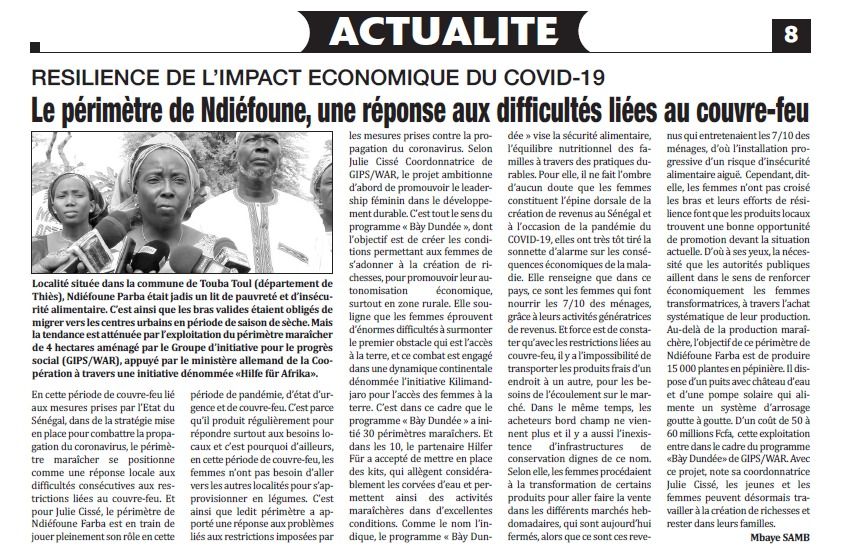
Julie Cisse, Director of WLP Senegal/GIPS-WAR, is featured in a national newspaper discussing how women can lead in the alleviation of food insecurity during COVID-19.
Women-Run Gardens Alleviate Food Shortages in Senegal
WLP SENEGAL/Groupe d'Initiatives Pour les Progrés Social/West Africa Region (GIPS-WAR)
Local community gardens cultivated by women, with the support of GIPS-WAR, have alleviated food insecurity during the pandemic. These food security programs for local women gained media attention and support from community leaders. GIPS-WAR’s director, Julie Cissé, explains that prior to the COVID-19 pandemic, women fed seven out of every ten households through their micro-businesses in Senegal. Current curfews and reductions in services have threatened that income. Learning to cultivate and maintain a garden has long-term wealth creation potential. At the same time, the gardens provide critical sustenance for women and their families when buying food from markets is both expensive and potentially dangerous due to the coronavirus.
KEDV Alongside Refugee Women Lead Community Response Efforts to COVID-19.
WLP TURKEY/Foundation for the Support of Women's Work (KEDV)
In Turkey, KEDV alongside Syrian refugee women coordinated community response efforts to COVID-19 using mobile phone communications platforms. In order to support virus mitigation at the community level, refugee women with the support of KEDV staff, began reaching out informally to their networks to send messages of solidarity and support. What began as an informal process quickly evolved into a coordinated response to the economic, political, and health issues caused by the pandemic. The women established a communication plan, using smartphone apps like WhatsApp, to check on everyone in their network and to disseminate information about how to protect families from COVID-19. They developed lists of at risk families, and provided them with information about where to find financial support and access to food, and other services. KEDV is now using this “phone tree” model to conduct surveys of needs, disseminate information, and support other groups with whom KEDV works, including refugees based in Istanbul and seasonal agricultural workers.
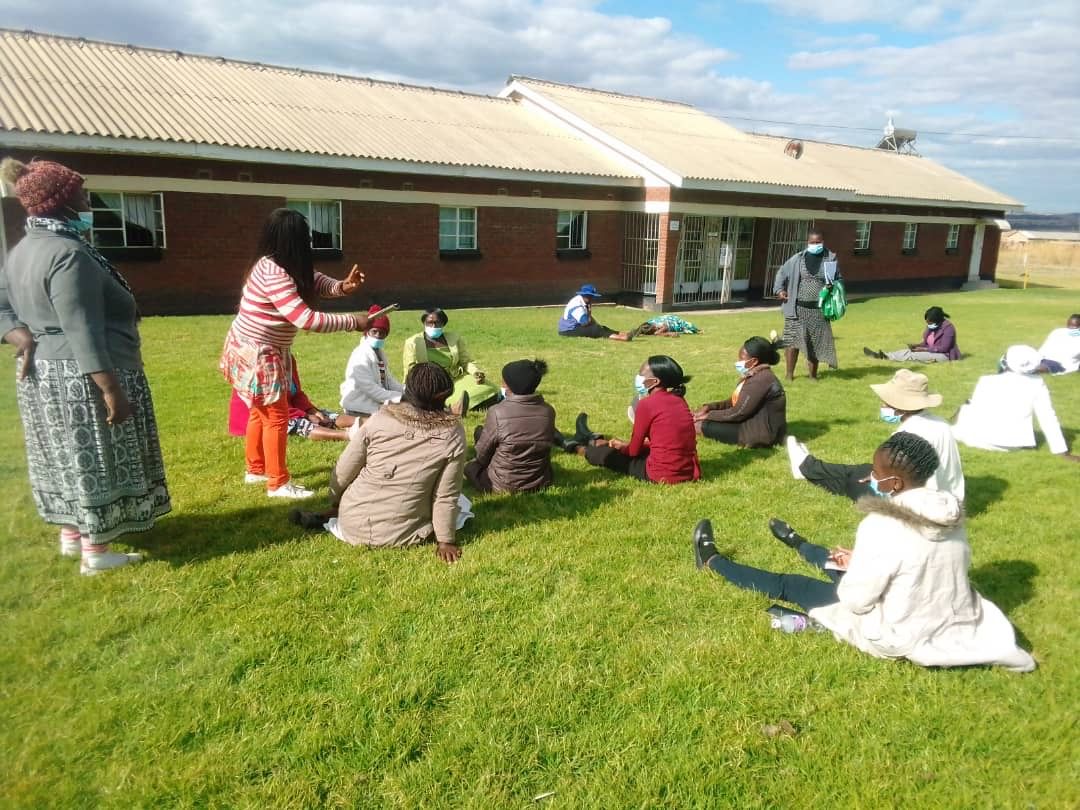
Participants of WLP Zimbabwe/WSPM’s political participation and leadership training enhance their skills while observing health guidelines for safe gatherings.
Activists in Zimbabwe gather to Increase Women’s Political Participation and End Gender-Based Violence
WLP ZIMBABWE/Women's Self-Promotion Movement (WSPM)
WSPM held two leadership workshops in August reaching nearly 50 Zimbabwean women and men. Trainers at the workshop used personal protective equipment (PPE) and social distancing to maintain the safety of participants during the workshop. At the first workshop, women enhanced their skills as inclusive leaders and grew their networks of leaders dedicated to increasing women’s political participation. Both the Minister for Women Affairs of Mashonaland East Province and the Mayor for the City of Marondera gave opening statements at the workshop. At a second workshop, over 25 young women and men strengthened their leadership skills, discussed strategies for ending gender-based violence, and proposed group advocacy initiatives for them to implement after the training.